SASRec

A product of SASRec Limited

Your health story,
in your hands.

One record that follows you to every clinic in Nigeria, written only by verified practitioners, opened only when you allow it.

Health ID

SAS-4K2P-9QX

Specimen card

Blood group O positive

Penicillin allergy, severe. Recorded by a clinician.

Show this at any clinic. The practitioner sees your history in seconds, and you decided what they see.

Your records stay at the hospital. You do not.

Visit a hospital today and your records stay there. Go to a different clinic next week and that doctor starts from zero. They ask the same questions. They order tests you already did. You pay again for answers you already have.

The information is not missing. A doctor wrote it down, a nurse recorded it, a laboratory processed it. It exists somewhere. What does not exist is any way for it to reach the next room you walk into, and almost every harm below comes from that one gap rather than from anybody being careless.

The Nigeria Data Protection Act 2023 already says those records are yours. Without something to hold them in, that is a right you cannot exercise.

SASRec Health is that tool.

38.1%

of Nigerian adults have hypertension. About 8% have it under control.

Nigeria Heart Foundation, 2024

512

maternal deaths per 100,000 live births. Nigeria carries a fifth of the world’s total.

WHO, 2024

15 to 25%

of test results in a fragmented system are never acted on by anybody.

Documented estimate, fragmented care settings

80%

of Nigerian hospitals keep their records on paper, so there is nothing to plug into.

SASRec ground survey, Ekiti

Five people. Five cases. Every one of them preventable.

Nobody here is named, but everything that happens to them is real, and it happens every week in Nigerian clinics. Each of the five stands for thousands of people, and we built this system around them.

01

A teacher, 34

Mushin, Lagos

Four doctors across three clinics in two years, none of them holding the record of the last. The fourth prescribed tramadol without knowing the third had prescribed amitriptyline. Two days later they were admitted in a serotonin crisis.

One shared medication list would have stopped the prescription being written.

02

A trader, 58

Kano

Told twice in two years, at two facilities, that his blood pressure was "a bit high". Neither doctor knew it was the second warning, so neither escalated. Six weeks after the second visit he had a haemorrhagic stroke and survived with partial paralysis.

Nobody was looking at the two readings together. A record that spans time does that.

03

A first pregnancy, 28

Port Harcourt

Twenty-eight weeks of antenatal care at a private clinic they could no longer afford the transport to. They arrived at a public facility at 32 weeks and it held none of it: not the sickle cell trait, not the borderline gestational diabetes flagged at week 20.

Their antenatal history should have reached the delivery room before they did.

04

A boy of 7

Ibadan, Oyo State

Treated for malaria and sent home. Three weeks earlier another clinic across town had sent a sample for culture. The result, bacterial pneumonia needing different antibiotics, came back two days after that visit, into a folder nobody opened again.

A result that cannot find the patient is the same as a result nobody ordered.

05

A seamstress, 45

Kaduna

Type 2 diabetes, managed with whatever medicine they could afford from whichever pharmacy was nearest. No HbA1c trend, no record of what they had already tried. Every consultation started their story again from nothing.

Their kidney damage was found years late because nobody held the long view.

Four steps, and you hold the last one.

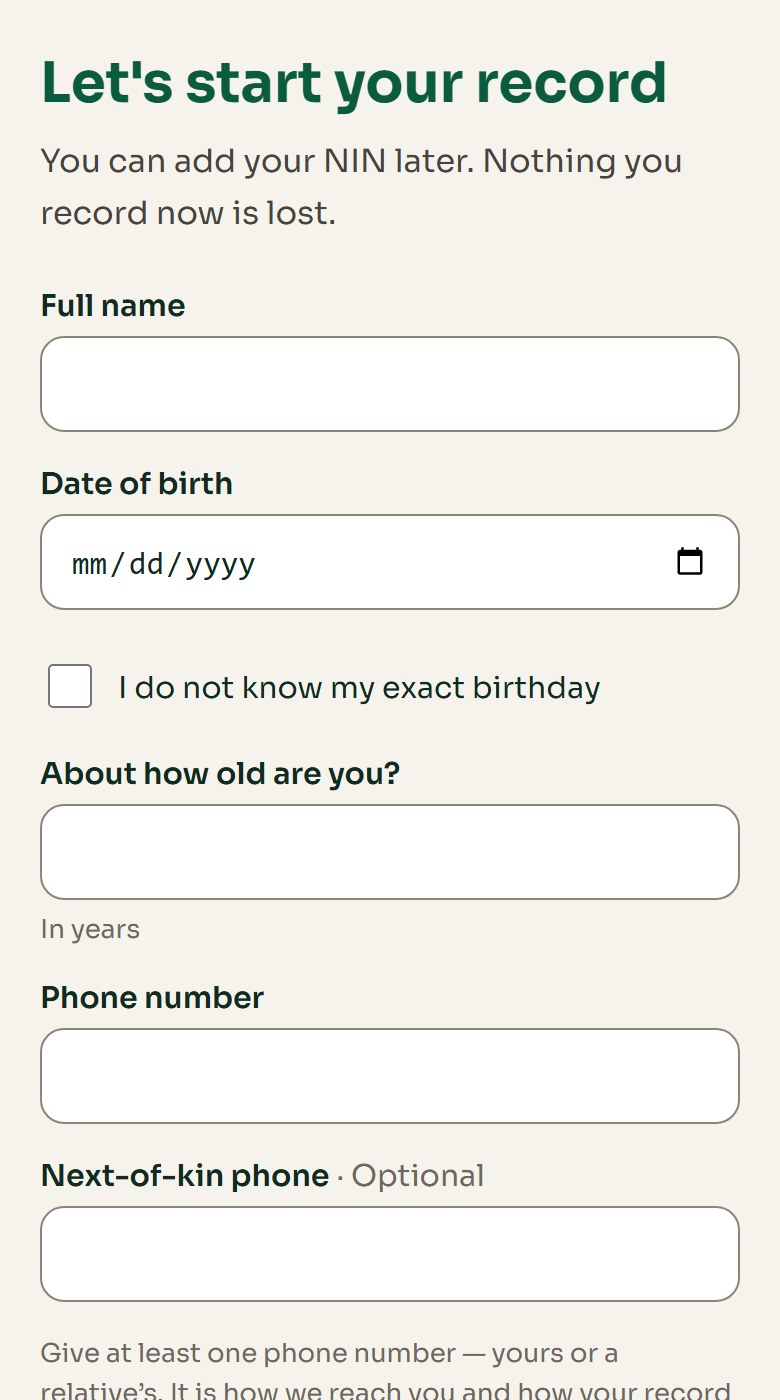
These are the real screens, not drawings of them. As you read each step, the phone shows the screen it happens on.

11:01100%
The registration screen of the SASRec Health app, asking for a full name and date of birth.
  1. 01

    A health worker registers you

    Your record is created against your National Identification Number, so it belongs to the real you. Your NIN itself is never stored.

  2. 02

    You leave with your Health ID

    Show it at any clinic, on your phone or on a printed card. It works with no battery, no signal and no data.

  3. 03

    Verified practitioners write it

    Every entry carries the name and MDCN licence of whoever made it. There are no anonymous entries, ever, and your whole history is in one place in the order it happened.

  4. 04

    You decide who sees it

    Access lasts a set time and can be revoked at once. Every time somebody opens your record it is logged, with their name and the time, and you can read that list.

See every screen, including the practitioner side

You already have everything you need to start.

Not a smartphone, not a data plan, not permission from the hospital that has your old file. You need a card in your hand and a practitioner who can read it.

You do not need a smartphone

Your record travels on a printed card that needs no battery, no signal and no data, and it works the same in a clinic that has none of those. If you carry an Android phone, the same record opens in the app.

It works when the network is down

The doctor in front of you reads your history and runs the drug safety checks without a connection. A warning that arrives 45 minutes after the prescription has already failed, so the checks happen where you are standing.

You do not need your old hospital to release anything

No forms, no requests, no waiting on records officers. Your record starts at your next visit and grows one consultation at a time, written by the practitioners who treat you.

It is in a language you actually speak

Every entry is written in plain words before the clinical ones, in English, Yoruba, Hausa, Igbo or Pidgin. You can read your own record, which is what lets you ask the next doctor the right question.

Find my nearest hub

Ekiti from September 2026, then outward. Tell us where you are and we will tell you where to collect your card.

For the patient

Anyone who has ever visited a hospital in Nigeria. Anyone managing a long-term condition. Anyone caring for a parent or a child. Anyone tired of starting from scratch at every new clinic.

Get your Health ID

For the practitioner

Any doctor, nurse, pharmacist or licensed professional who wants patients to walk in prepared. Less time taking a history. More time giving care.

Get verified

The promises we can keep, and how.

A promise is worth what enforces it. Each one below is answered by the thing in the system that makes it true, because a policy can be revised on a Friday and a database constraint cannot.

Only verified practitioners can write to your record

Every practitioner is checked against the Medical and Dental Council of Nigeria register before they can add a single entry, and their licence number is stamped on everything they write.

What makes it true

Every clinical row carries an MDCN identifier. A record with no verified practitioner behind it cannot be written at all, so there are no anonymous rows to find later.

You can see everyone who opened it

Each access is written to a log you can read: the actual list, with names and times, rather than a summary of it.

What makes it true

The consent record can only be added to. A database trigger refuses any attempt to change or delete a line of it, so the history of who was allowed in cannot be quietly rewritten, by us or by anyone else.

Your NIN is never stored

Only a one-way fingerprint of it is kept, salted per person, which cannot be turned back into your number.

What makes it true

The number itself is never written down, not in a column and not in a log line. Someone who steals the whole database still does not have one usable NIN.

Never sold, never advertised against

Your record is not a product, and access to it is never open-ended.

What makes it true

Every grant expires on its own, a day for an ordinary visit and three for an emergency, and you can revoke it before that without asking anyone.

Twenty-three places in one state, and a record that cannot cross between them.

One illness in Ekiti can cross a teaching hospital, a general hospital nearer home and a private laboratory. All three write something down. None of them can read what the other two wrote.

Week one

A teaching hospital in Ado-Ekiti

They are admitted, treated and discharged with a diagnosis and three medicines. Every part of it is written down, and every part of it stays in the building.

They leaves with their memory of it and a folded discharge note.

Week three

A general hospital nearer home

The doctor there begins from what they can remember: the diagnosis if they caught the word, the medicines if they kept the packet.

He prescribes around a list he cannot see.

Week four

A private laboratory in Ado-Ekiti

A sample is sent and a result is created for a patient the laboratory will never meet. It reaches the clinician who ordered it, or it reaches a folder.

Nobody downstream learns it exists.

With a card in their hand, those three visits are one record.

Each practitioner reads what the last one wrote before they prescribe, the laboratory result lands somewhere a person will see it, and they can read the list of everyone who opened their record.

Get your Health ID

Twenty-three facilities serve Ekiti: 4 teaching and tertiary, 2 state specialist, 8 general, and 9 private hospitals, clinics and diagnostic centres. That is the map, not a list of partners, and none of them has endorsed SASRec Health. When one does, we will say so by name and you will not have to guess.

See the facilities by tier

4

Teaching and tertiary hospitals

Afe Babalola University Multi-System Hospital, 400 beds · Ekiti State University Teaching Hospital · Federal Teaching Hospital, Ido-Ekiti · Federal Medical Centre, Ikole-Ekiti, upgraded from a state specialist hospital in July 2024

2

State specialist hospitals

Ikere-Ekiti · Ijero-Ekiti

8

General hospitals

Aramoko-Ekiti · Iyin-Ekiti · Emure-Ekiti · Ode-Ekiti · Omuo-Ekiti · Ifaki-Ekiti · Efon Alaaye · Oke-Igemo

9

Private hospitals, clinics and diagnostic centres

Concentrated in Ado-Ekiti, with others at Ido-Ekiti and Otun-Ekiti, including the state’s diagnostic and pathology laboratories

Ekiti goes first, in September 2026.

SASRec Health opens across Ekiti State, and the doctors, patients, health workers and students there are the first Nigerians to carry their own health story. This is what your first day with it looks like.

01

You register once, at a hub near you

A health worker confirms who you are and prints your Health ID card while you wait. It needs no phone, no data and no battery, and you never register again.

02

You show the card, anywhere you are treated

Any practitioner verified against the MDCN register reads your history in seconds: your blood group, your allergies, and everything you are already taking. You stop starting from the beginning at every new clinic.

03

The record stays yours

Every new prescription is checked against your medication list before it is written, and you can see the name and the time of every person who opened your record.

Find my nearest hub

Ekiti first, then outward. What we learn there is what goes national.

Get your Health ID.

Tell us where you are and we will send you the nearest place to collect your card, what to bring, and how long it takes. You walk in, you walk out with your Health ID, and you stop repeating your history to every new doctor.

We collect what is on this form and nothing else. It reaches the people running SASRec Health in Ekiti, we use it to contact you about your registration, and it is not a mailing list you have to escape from later.

We cannot do Ekiti from Lagos.

A health record takes root through people a community already trusts, not through advertising. We are writing to the organisations below, but we would rather hear from you first.

EKSU Medical Student AssociationFUOYE Medical Student AssociationABUAD Medical Student AssociationNMA, Ekiti State branchEKSUTH Department of Community MedicineEkiti State Pharmacists AssociationNursing and Midwifery Council, Ekiti chapterEkiti State College of Health TechnologyCommunity Development AssociationsChurch health ministries in Ado-Ekiti

Bring your organisation in

A partner gets access for its members and a session where we explain the platform and answer for it in person, on your campus or wherever you choose. We name every partner wherever we name our partners.

Volunteer as an individual

Ambassadors and content creators carry this to patients and health workers through networks we do not have. With the medical student associations we want to run a WhatsApp channel where students publish plain, accurate health information for the Ekiti public, people writing to people, which is a different thing from the system messaging you.

We are asking for a meeting, and for the chance to speak to your members.

Start a partnership

Tell us who you are and what you would want from this. We will write back to arrange a meeting, and we will come to you.

0813 276 2591